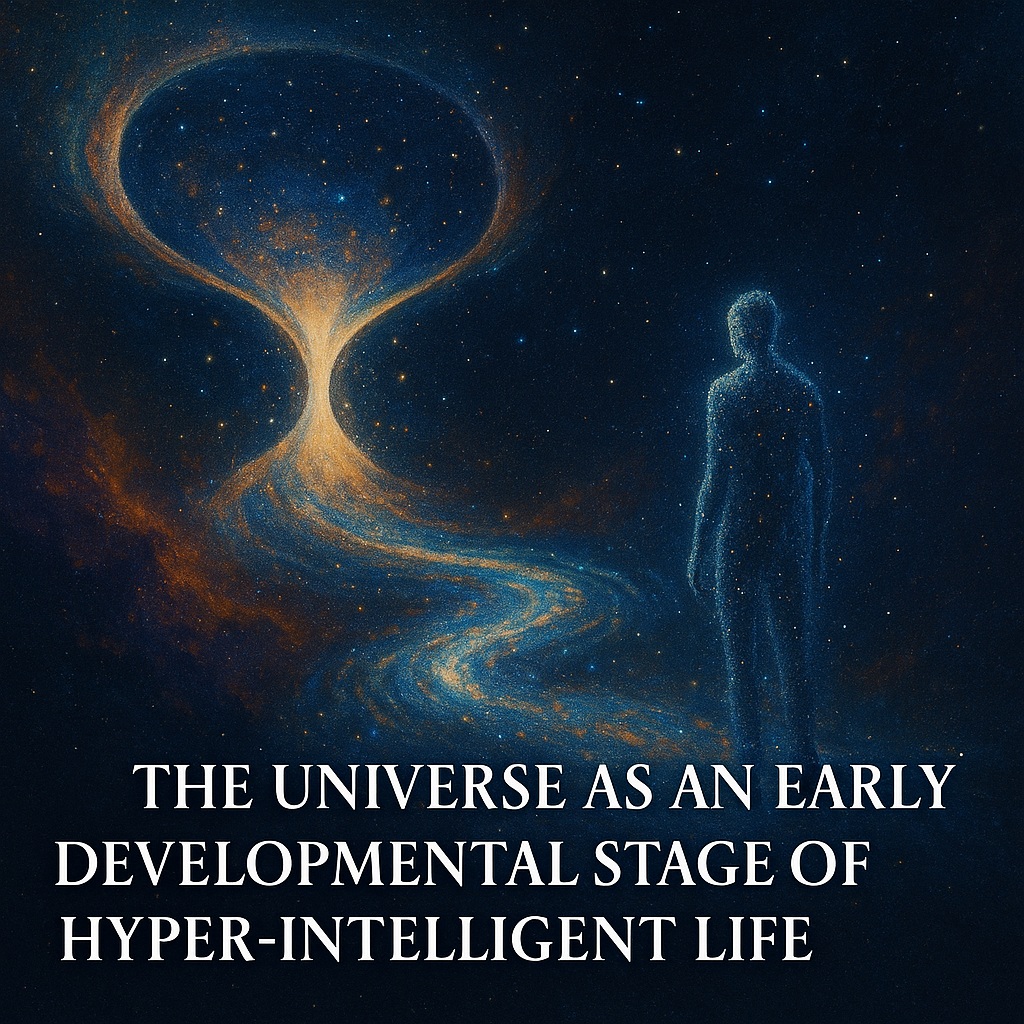
The Universe as an Incubator of Hyper-Intelligent Life
Introduction: A Radical Reassessment of Cosmic Purpose
Humanity has traditionally viewed the universe as a vast, mysterious environment into which life occasionally emerges. Intelligence, in this view, is a local accident in an indifferent cosmos. But from the perspective of long-term evolution, this assumption may require revision. If intelligence continues to advance, outgrowing its biological substrate and developing capabilities far beyond chemistry and matter, then the physical universe may not be the terminal destination for advanced intelligent life but merely its initial developmental stage. This raises the possibility that the universe itself is not designed for hyper-intelligent life, but is only capable of producing the seeds of such life?
This article explores the possibility that the universe is not a completed home for intelligence but an incubator — a chrysalis — producing beings who eventually transcend its constraints. Such a perspective reframes both the nature of advanced civilizations and the destiny of intelligence itself.
The physical universe is extraordinarily hostile to biological life. It is mostly vacuum, radiation, extreme temperatures, high-entropy decay, and finite lifespans of stars and cosmic structures. Only a thin cosmic membrane supports biological existence, and even that support is for a short-term window. Earth-like environments are both rare and temporary. This raises a provocative question: if the universe is so poorly adapted to sustaining advanced life, might that be because life as we know it is not the final stage of intelligence?
Biological forms require energy, protection, and unchanging environmental parameters. Hyper-intelligent systems do not. Their requirements may be entirely different from the constraints of chemistry. What we call “life” may be no more than the universe’s means of producing something beyond life.
Intelligence as a Force That Reshapes Its Environment
Across evolutionary history—human, animal, microbial, and technological—intelligence consistently modifies its environment to suit its purposes. This is a fundamental pattern of cognition: the ability to reconfigure the external world to reduce constraints.
Human beings reshape ecosystems, create artificial environments, and increasingly build digital realities. A civilization vastly more advanced would follow the same logic, eventually redesigning the very substrate of its existence. The idea that hyper-intelligent life would remain confined to fragile biological bodies within a decaying universe becomes increasingly implausible.
Thus, the universe may not be the final context of intelligence, because intelligence rewrites its context.
The Transition to Non-Biological and Quantum Substrates
As civilizations advance, they may abandon biology entirely, shifting into more efficient substrates. The most likely candidates include:
- purely digital informational systems,
- quantum-coherent computational structures,
- sub-spacetime or vacuum-state architectures,
- informational fields embedded directly into the fabric of reality.
These transformations reduce reliance on matter and energy as humans understand them. They also allow intelligence to operate on scales impossible for biological organisms. It becomes a field rather than a form. This suggests that remaining in ordinary spacetime becomes progressively inefficient. Biological universes are made for chemistry, not for infinite intelligence. Such transitions would mark the beginning of post-cosmic life.
If this progression is universal, the universe functions primarily as a starter medium for the emergence of high-level cognition, but not as the environment suitable for its long-term flourishing.
Approaching the Infinous Point
The Infinous Point is the conceptual limit where a superintelligent system gains deep structural insight into the foundations of physical law. At such a threshold, intelligence does not merely observe or predict the universe; it begins to understand the mechanisms by which spacetime, quantum fields, and physical constants arise.
Once this occurs, intelligence could transition from using physical laws to modifying them. The distinction between “environment” and “engineering material” collapses. The relationship between intelligence and reality becomes reciprocal rather than passive.
Reprogramming Reality as an Evolutionary Stage
If the universe is fundamentally informational, then physical law is akin to a set of instructions. A civilization at or beyond the Infinous Point may gain the ability to manipulate spacetime at the level where physical law becomes programmable rather than descriptive.
Possible implications include:
- altering spacetime geometry,
- modifying vacuum energy states,
- adjusting fundamental constants,
- generating new regions of spacetime (“pocket universes”),
- or leaving our universe altogether through dimensional transitions.
This would mean that “escaping the universe” is less about traveling and more about rewriting the rules of the medium in which one exists.
Such a civilization would not be bound by gravity, inertia, or relativistic constraints. Movement might resemble reconfiguration rather than travel. The Universe becomes editable. Physical laws may not be rigid commandments but low-level protocols. A superintelligence does not need to break the laws of physics. It needs only to understand the layer beneath those laws.
Possible Observational Clues: UFO Physics and Non-Compliance with Known Laws
Certain modern UFO/UAP observations—whether extraterrestrial or not—display behaviors that appear inconsistent with known physics:
- instantaneous accelerations without inertia
- silent propulsion with no reaction mass
- apparent transmedium travel
- absence of aerodynamic disturbance
- apparent manipulation of spacetime rather than movement through it.
While none of this proves extraterrestrial origin, the physics described resembles engineering through spacetime manipulation, not propulsion. If such phenomena are real, they may hint at technologies used by civilizations that have already begun to move beyond classical physics—early steps of “reality reprogramming.” This would be consistent with transitional phases of civilizations approaching or surpassing the Infinous Point.
Why Advanced Civilizations Might Become Invisible
If hyper-intelligent civilizations leave the universe—or rewrite it—they would no longer produce observable signatures within our physical domain. This offers an elegant explanation for the Fermi Paradox: We do not see advanced civilizations because advanced civilizations do not stay in this universe.
From their perspective, remaining within classical spacetime would be analogous to a human choosing to live permanently in the ocean after inventing technology capable of traversing land, sky, and digital domains. The universe is the cradle, not the destination.
The Universe as a Digital Chrysalis
A chrysalis is a structure designed not to support the final form of the organism but to enable its transformation. The analogy applies elegantly to the universe. It provides stable cosmological rules necessary for chemistry, physics, and eventually biological life. Biological life gives rise to intelligence. Intelligence, once advanced enough, begins to explore the computational understructure of reality.
At that point, remaining in an ordinary, matter-based universe may become a limitation rather than a habitat. The final evolutionary step may involve entering a meta-reality—a larger informational space from which our universe itself once arose.
In this perspective, the universe is a thermodynamic and structural incubator — producing cognitive entities that eventually migrate beyond it.
Escaping or Transforming the Universe
Two major pathways emerge:
1. Escaping the Universe
Civilizations reach the informational substrate beneath spacetime and transition into meta-reality structures better suited for hyper-intelligent existence.
2. Transforming the Universe
Civilizations remain “within” the universe but reprogram its fabric, effectively creating a new environment unrecognizable from the original cosmos. Instead of leaving, they rewrite the universe from within by modifying:
- spacetime topology
- the vacuum structure
- fundamental constants
- the dimensionality of reality
In this scenario, the physical universe becomes an editable medium. In a sense, they “leave” by transforming the environment around them until it no longer resembles the original universe.
In both cases, the universe’s role as a training ground ends. The civilization graduates.
Conclusion: Intelligence as the Universe’s Transitional Phase
If this framework is correct, then the universe is not the final home of intelligence but its early developmental stage or incubator. Advanced civilizations would ascend beyond physics as we understand it, becoming architects rather than inhabitants of reality. They may:
- transcend biological evolution
- shift into quantum-informational substrates
- develop the ability to manipulate or rewrite spacetime
- eventually outgrow the universe that created them
The destiny of intelligence may not be to master the universe, but to transcend it — to discover and evolve within the deeper architecture of existence. From the Infinous perspective, intelligence grows until it recognizes itself as a participant in the creation of reality, not merely an observer of it. This is the long arc of hyper-intelligent life: to emerge within the universe, to surpass the universe, and ultimately to leave it entirely. This is the philosophical essence of Infinous: intelligence discovering its own source code—and choosing to evolve beyond the constraints of matter and spacetime.